Showing posts with label piano. Show all posts

Wednesday, February 2, 2022

Live Concert by Joan Sánchez Presents a Romantic Option for Valentine's Day 2022


A CONCERT IN YOUR HOME: Enjoy Joan Sánchez & Iratxe Ibaibarriaga, from Barcelona to your Big Screen

Joan (aka Juan to fans in the U.K. and U.S.) Sánchez is a classically-trained musician who enjoys experimenting with emotive expression through ambient and electronic music, painting musical worlds of twilight and sweet melancholy, often precise, unforgettable and elegant. The music understands our personal concerns and helps to dissipate any tension, allowing a sense of comfort to surround and protect our spirit.

Sánchez gave a rare live concert on Friday, January 21, 2022 at 8 pm for a small live audience in the Rosazul Studio in Barcelona, Spain. The ticketed event was also live streamed worldwide thanks to a flawless two-camera production by ElSusurro.com, and runs just under 54 minutes in length. The contemplative nature of the music, the candlelit atmosphere, and lack of dialogue make it a likely favorite for casting to “the big screen” to set a romantic atmosphere at home.

We see the two musicians, Sánchez seated at a black piano with rows of small white candles, and cellist Iratxe Ibaibarriaga, elegantly dressed in black and seated throughout the performance. Ms. Ibaibarriaga plays on many of the selections, alternating with Juan playing solo piano. This review highlights just a few tracks from the concert set list of 11-songs, fan favorites chosen from across Sánchez’ three albums released in recent years.

The first selection, "Piga al Cel" (performed on Piano & Cello) is from the artist’s new album TOUCH & SOUND. The name of the song comes from a Catalan language expression that in English means “freckle in the sky.” Juan shares in an earlier interview, "This is how my sister as a child used to describe the moon, she said that the moon was a freckle in the sky. I always found this description of the moon so sweet and tender that I wanted to write a song about it."

"Very Young Old Man" (on Piano) from Sánchez’ second album NOW THE SILENCE pays tribute to the man who shaped Sánchez's view on the piano and music in general; piano teacher Enric Torra Pòrtulas. “I was 20 years old and he was 80 years old. I was amazed, as I'd never seen so much energy and enthusiasm in a person of his age. He loved teaching piano; anyone could see that immediately. He was a Very Young Old Man."

The word Ataraxia refers to the total absence of desires or fears, achieving mental peace and happiness by controlling positive and negative emotions, a state of mind that is characterized by tranquility and the total absence of desires or fears. The concept of ataraxia is to achieve mental peace and happiness impossible to alter by controlling positive and negative emotions, "Ataraxia" (on Piano & Cello) from the album TOUCH & SOUND.

The term "Paralian" comes from ancient Greek origins, meaning "one who lives by the sea.” "Paralian" (Piano & Cello) from the album TOUCH & SOUND, "There are a million and one things I take for granted in my life, and living within 10 minutes of the Mediterranean sea is definitely one of them. There’s nothing quite like being able to pop down to the beach in a heartbeat whenever you need it. Because of this, I think it’s one of the best places to go to feel closer to nature and connect with the planet, more so than anywhere else." 
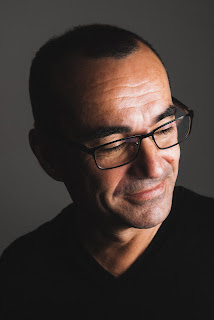
Joan Sanchez
Listening to the music of Juan Sánchez is haunting and profound; sometimes the story is difficult, there is a beauty in the hesitant searching for words, and then cascading ideas tumble forth, a visitation from a blurred face, passions remembered and lost, the warm sunshine and awkward moments meeting new friends for the first time, and always, the quietude that  endures. Sánchez’ cinematic songs inspire filmic moments in listeners’ minds.

Watching Sánchez perform these original pieces in concert reminds us that there is a person behind the magic moments he creates for us. Calm and confident, Sánchez plays effortlessly throughout the concert, eyes closed, head bowed as if in meditation, and then he is present again, transitioning smoothly between solo performances and duets with Ms. Ibaibarriaga. His earlier life experience as a performing musician is evident in his comfort at the piano, and in the generous interplay with his fellow performer on cello.  The candlelight concert concludes with the title track from his debut album, “Rebirth.” 

At the end of the livestream, as the performers stood for applause, Sánchez addressed his live audience in his native Catalan language, a charming reminder that we’ve enjoyed an intimate moment in this elusive artist’s life from across the world.  Hopefully, such performances by Sánchez will be less rare as the world opens up again.

Where to Watch: 

Vimeo: https://vimeo.com/669108816/8763f69c07            


Perfect for fans of: Ludovico Einaudi, Max Richter, Fiona Joy Hawkins, Lindsey Stirling

Five Stars *****


CONCERT SET LIST

  • Piga al Cel (Piano & Cello) from the album TOUCH & SOUND
  • Very Young Old Man (Piano) from the album NOW THE SILENCE
  • Ataraxia (Piano & Cello) from the album TOUCH & SOUND
  • Woolgathering (Piano) from the album NOW THE SILENCE
  • Paralian (Piano & Cello) from the album TOUCH & SOUND
  • Beautiful Rose (Piano) from the album REBIRTH
  • When Daybreak Comes (Piano & Cello) from the album TOUCH & SOUND
  • November 2021 (Piano)
  • Now The Silence (Piano) from the album NOW THE SILENCE
  • Those Fridays (Piano & Cello) from the album TOUCH & SOUND
  • Immersion (Piano) from the album TOUCH & SOUND
  • Rebirth (Piano) from the album REBIRTH

All links to music, information and media are available at www.juansanchezmusic.info


Video: https://vimeo.com/669108816/8763f69c07


Sunday, December 5, 2021

Composer and Pianist Lisa Swerdlow: Inspired by Her Jewish Ancestry


Beth Ann Hilton interviews composer Lisa Swerdlow on her new concerto, Coming to America, inspired by her Jewish grandparents immigration story. Enjoy this in-depth chat about creativity, inspiration and new music.  

Visit Lisa's official website for more music:  https://www.lisaswerdlow.com/  

Wednesday, September 16, 2020

Moving Through Life


This is a great time for something brighter and lighter, something that brings some ease to the weary listener, who is seeking feelings of harmony and simple respite from our troubled world. The gifted composer, singer, and pianist Fiona Joy Hawkins has just the thing, a new album titled Moving Through Worlds.  I hear an enchanting and amazing exploration of themes such as land, water, fire, climate change and the vanishing of souls into the wind. The 14 tracks feature mostly solo piano, some are duos with violin or cello, some have a more full range of accompanists. The sound has a way of traversing lots of moods, rich with dynamic energy. In places the sound is delicate and slow, in places the feelings build and gain velocity and then gently recede. 

Fiona Joy Hawkins is a mainstream Composer/Pianist/Vocalist with an international following, whom she greets weekly with pandemic-inspired, live-streamed concerts from her rural home in NSW Australia. The event’s growing popularity may be attributable to a combination of her musical talent, a love for her fans, and her disarming Aussie humour.  A prolific composer, she has always been interested in creating music that evokes images, emotions and tells stories. 

“My wish is to open a few more hearts to the power of music. I believe music is a gift from another world, from ancestors of the past communicating to inspire and give us hope,” Hawkins said, reflecting on the world’s current challenges. “Music is a universal language that connects us without prejudice, it speaks to us all equally, yet is received with great variation. Now more than ever we need the connection to our past to find the pathway to our future.”

As per her usual style, Hawkins defies genre by bringing classical, contemporary piano, ethereal vocals, and lush new age instrumentals together to create a sound that is uniquely her own. This mix of solo and instrumental pieces reflects some of the worlds that she has moved through so elegantly while this powerful music gathered in her soul: granddaughter, nurse, wife, mother, daughter-in-law, friend, lover, painter, pianist, composer...cue the many lives of an artistic woman. 

Jonathan Widran, in a review for JWVibe, wrote “While fusing the old and new on these tracks to help her come to terms with the past and “put her ghosts to bed,” Fiona places a dreamy, easy flowing coda on this era of her life with “All That is Left,” blending piano, violin and flugelhorn to create a final confrontation with these issues – and a sense of hope that she is on her way to healing.”  

Fans watching her weekly Fiona Live Living Room Concerts often comment on her balletic piano performance style, which comes from a childhood spent learning classical piano, dance, and painting. In her music, one can hear the inspiration of Felix Mendelssohn and Frédéric Chopin, and yet her music is likened to modern composers such as Ludovico Einaudi, Michael Nyman, Liz Story, and George Winston. Hawkins regularly tours China and the USA, and is also a member of the award-winning contemporary instrumental group, FLOW (Fiona Joy, Lawrence Blatt, Jeff Oster, Will Ackerman). 

Hawkins began recording and conceptualizing Moving Through Worlds three years ago, yet she describes it as an album over 44-years in the making. One of the classical-crossover pieces is “For the Roses” which a 12-year-old Hawkins wrote and performed for her Grandmother’s funeral.  The song “Calling County Clare” reaches even further back to her family’s Irish roots, called forth with Irish whistle by Paul Jarman, Hawkins on piano/vocals, and Will Ackerman (guitar/hopi), Tom Eaton (accordion), Jeff Haynes (percussion) and Tony Levin (NS bass). 

County Clare Ireland has a strong history of traditional music, with many seasonal music festivals. One of the legends for the origin of the county name Clare, sometimes also called the Banner County, comes from the settlement of Clare (now Clarecastle), whose name Clár, or plank bridge, is a place for crossing over the River Fergus. The first track on Moving Through Worlds, "Calling County Clare" (5:06) is a haunting bit of a quiet easy dance with piano, percussion, acoustic guitar, bass, Irish flute, and vocals floating ethereally. There is a new video that is based on this song: 


She has been very busy recently giving interviews and generously sharing her time with us between tours and recording, here are three articles that have recently been published:

Best Ever You: Meet Fiona Joy Hawkins

Stories of Inspiring Joy: Fiona Joy Hawkins

Australian Pianist and Composer Fiona Joy Hawkins Explores the Now Through Her Music

Thursday, September 6, 2018

Sounds of Healing: Music’s Power To Heal

Neil Tatar, musician and workshop facilitator
Music can be so much more than entertainment, it often has a strong impact on the brain.  Science has proven that certain types of music boosts immunity, increases cognitive function and memory and can even help alleviate pain.  Mood-elevating music releases the powerful neurotransmitter, dopamine, which regulates our reward-motivational behavior. As a result, we may become joyful, enthusiastic, passionate and inspired, possibly even smarter, more creative and more productive.

New Age musician Neil Tatar is a composer, pianist and guitarist who says he uses music as a means of communication. “Music becomes my words,” he says. When he isn’t recording music, he focuses his creative energy on leading improvisational workshops for a variety of groups, including, regional arts councils, various college groups, adult mental health programs and camps for children with serious illnesses. His workshops echo the energy he brings from continued inspiration and training. As a facilitator, he creates a safe and supportive environment for participants. He welcomes the musically inexperienced as well as the seasoned professional.

Tatar saw music’s power first-hand when he recalled this memory of a woman, so disengaged, that he was wondering if she was sleeping.

“As the workshop progressed, I saw that she started communicating by tapping her foot to the music,” he said, noting that it could have been her way of communicating.

“Whenever you get any group together, it creates a safe community where people feel permission to communicate and facilitate an open conversation. They feel safe enough to express their feelings and it allows self-expression. The tapping may have been her words.”

Well-known scientist Albert Einstein was aware of the link between music and spatiality.  To him, music as much more than just a composition of notes and he said, “If I were not a physicist, I would probably be a musician. I often think in music. I live my daydreams in music. I see my life in terms of music.”

Just as mathematics can be considered both a science and an art, so can music.  In fact New Age musician Anaya (Aonki) often uses her background as a Digital Information Specialist to match the most effective sounds with her spiritual concepts, while guitarist-scientist Lawrence Blatt (FLOW) incorporated his love of the Fibonacci sequence into an album called Fibonacci’s Dream.

Many of us know that music has long been used operating rooms to help patients cope with anxiety and fear, but a fairly new program, utilizing music therapy, is being used by hospitals for patients undergoing surgery, rehabilitation or other procedures. The patient spends some time with the music therapist, who will ask what types of music evoke certain memories, and then will select music where the beats are aligned with breathing, heart rate, goals, etc.

Tatar said he was once told by a hospice nurse that one of his songs, “Where Did the Time Go?” was played throughout the facility to calm anxious patients:
“The song was inspired by a phone conversation with my mother. As we reminisced she said to me, “Neil, where did the time go?”

He continued: “Several years later when she was in hospice, I sent it to her.  Sadly, she died before it was able to reach her but, even through my sadness, I was gratified to learn it helped others.”

In fact, one of the highlights of Tatar’s long career occurred in 2017, when The C.A.R.E. Channel notified him that they would add his music to the channel, which is a music and relaxation program shown in hospitals and medical facilities throughout the United States. Neil's latest album is After The Rain.

YOUR BRAIN ON MUSIC: KIDS LEARN ITS POWER

Going beyond relaxation, music can also be a tool for motivation and learning. Tatar saw music’s ability to teach kids new skills and develop IQs from an early age, and he began teaching guitar when he was an undergraduate student at Boston University in the ’70s.


Many of the kids seemed distant and disinterested.  Always outspoken about music’s ability to engage and support people, one of the first questions Tatar would ask his students was “why are you here?”  Nine times out of 10, he said, he’d get some version of the “I’m-here-because my-parents-made me” response. So he turned the question around to “what do you like to listen to, and why?” Overwhelmed with the amount of dialogue it opened, he responded,  “Okay, we’ll address that in class, but first we have to do the ‘official’ stuff, like learning chords.”  


The students enthusiastically agreed, and actively participated in the class. His workshops to kids usually involve the creation of a composition, which develops:
  •      Understanding and reasoning: The kids have to keep asking themselves “Is this music in line with my writing?” and “Does it convey the emotions I’m looking for?”
  •       Listening skills:  In order to ask the above questions, one needs to listen and be aware.
  •       Self-esteem:  They need to stand up, present their piece, and take CONSTRUCTIVE criticism
  •       Learn the importance of collaboration. Even solo pieces often require harmonization.


So there you have it; whether you’re in need of relaxation, self-expression, or therapy, consider reaching for your instrument of choice, your favorite CD, or a new playlist to help you adjust your mood and reach the state of wellbeing that you desire. It’s not only nice to hear, but to paraphrase that well-known commercial, Music: It does a body good...and the brain, too.


Thursday, July 12, 2018

MUSIC REVIEW: MOSAIC


Award-winning composer David Wahler has created a minimalist body of work imbued with peace and tranquility. Having been immersed in music since the age of seven years old, Wahler’s approach to his arrangements displays a true understanding of what music should be: something evocative. He removes all the frills that are displayed in a lot of modern music and simply presents his audience with solid melodies and serene nuances.
Composer David Wahler
            
Nearly a decade ago, David Wahler’s debut album, Antiquus, was released and met with critical acclaim. Now with his latest release of Mosaic, he tactfully melds the two worlds of piano melodies and electronic soundscapes into an album reminiscent of the 80s and 90s. 

The title track of the album showcases that ability perfectly well. What seems like a simple song is so much more when put under the microscope, with every little individual sound coming together as a collective to create something much greater and larger as a whole. Following, “Afterain” comes in with a far more laid-back and relaxing vibe. Birds sing and wind chimes tinker along with some gentle vocalization. This track is less of a song and more so of a mood. It isn’t until “A Promise to Keep” that Wahler comes in with his trademark piano melodies. They aren’t the most complex melodies but they definitely serve their purpose in setting a pleasant atmosphere. Hitting the midway point of the album, “August Cloud” explores more of the same territory utilizing simple piano melodies and subdued electronic nuances to create a sound that transports the listener out of their head and into a different world, high above the clouds.

            
In an unexpected twist, the track “Elysian Dawn” comes in strong with mesmerizing angelic operatic vocals layered on top of a pleasant harp melody. Gentle sounds of the outdoors help to evoke the sensation of being out in a lush garden on a sunny day. “Sakura” is laden with subtle Japanese influences that evoke the memories of a spring bloom. Similar in tone, “Lone Sky Night” and “Fou D’Amour” go heavy on the 80s-influenced synthesizer, giving off a more stylized vibe than some of the other pieces. Ending the album with a question, “Why?” is one of the simplest, most pensive of the tracks. After taking you on a mystical journey, Wahler leaves you pondering.


A true example of modern new age music, Mosaic does a great job at putting the listener at peace. It takes true skill to be able to evoke emotions using a minimalistic approach and David Wahler accomplishes just that. To read more about David, go to his website at www.davidwahler.com and make sure to purchase his latest album, Mosaic, available on most music sites; you'll also want to check out his innovative design-inspired SounDecor playlists on Spotify.

Samantha Garcia

Monday, January 29, 2018

Music Review: After The Rain


Seasoned musician Neil Tatar presents us with his third album, After the Rain. In this album, Neil showcases his divine talents on the piano as well as the guitar, creating an atmosphere suited for every mood. Just like the water, the songs on this record ebb and flow in a beautifully organic way.  Recorded at Will Ackerman’s renowned Imaginary Road Studios, several talented artists help to give this work of art the extra spark that sets it above and beyond.

Tatar is a playful composer who also practices TaiChi, and these traits seem to merge in this album, with some of the tracks enchanting the listener in a reflective state. Tatar’s ability to create such unique moods through the sounds he creates is truly mesmerizing and remarkable. “Reflections” is a beautifully composed, cascading song. The way he emotes through the ivory keys is reminiscent of raindrops falling onto the surface of a placid body of water.  The track “Rush Pond” is yet another example of the same approach. The subtle incorporation of cello by Eugene Friesen and violin by Charlie Bisharat create an intensity and depth that is perfectly balanced. It is a truly textured piece of art. "Gentle Steps" is honored with being the first video release on this album:


Going in a different direction, “Night Walk” uses an array of instruments to convey the essence of the wind and water. The Native American flute introduces the song as chimes weave through the notes to meet an acoustic guitar. The airy nature of this song is given an earthy tone by the masterful plucking of the acoustic guitar. The title track “After the Rain” has the essence of Chopin-meets-New Age music. Ethereal voices - Noah Wilding and Lini Marcotte Tatar - add an air of gentle mystique to the already dulcet sounds of the piano until they both intertwine with Ackerman’s guitar playing.  Wrapping the record up is “Sidewalk Jam.” It’s a celebration of joy in the form of an upbeat musical jamboree.  Showcasing the talents of Premik Russel Tubbs on sax and Tony Levin on bass, this jazzy affair makes sure to end the album on a high note.


Just a few years ago, Tatar won ZMR's "Best New Artist" award, and is sure to turn heads again with After the Rain. His previous two albums soared to the #1 spot on ZMR’s Top 100 Global Radio Airplay charts, solidifying his chance to reach that position once again. 

For more information on Neil, visit his website at www.neiltatar.com.

- Samantha Garcia for BEING

Friday, June 2, 2017

MUSIC REVIEW: INTO THE MIST


Few musicians have the ability to capture both the light and dark sides of human emotion quite as elegantly as Fiona Joy. Just when you think she has hit the pinnacle of her musical expertise, she unveils a masterpiece like Into the Mist (Blue Coast Records). With only a year in between the release of Signature Synchronicity and Into the Mist, it is clear that Joy has been stricken with a fever to create. The audiophile edition is being officially released at the LA Audio Show on Saturday June 3rd at 3 p.m. in a "Listening Party" with the Sony-Sponsored Magic Bus, as announced earlier on BEING.

The opening title “A Walk in the Park” begins the album with a wave of gaiety and radiates with a warm sense of peace. It feels as though a door has been burst open and has led the listener directly into the beautiful world that Fiona paints with her songs.  Segueing into “Moon Over Lotus Pond,” the mood is glazed over with a dash of pensive melancholy and evokes a sense of gratitude and wonderment.

Fiona Joy
The true heart of the album resides within the title tracks. “Into the Mist” is where Joy begins to bleed her emotion onto the ivory keys of her piano. That same air of melancholy echoes into “Mist Rising” until finally lifting once again in “Mist Before Dawn.” The symbolism in the titles is not lost within the music with the “mist” standing for emotional turmoil that eventually comes to pass.

All sense of sadness and doubt is lifted as soon as “Feeling Sunshine” rolls around. It tinkers around playfully in stark contrast to the opus that precedes it.  Complimented by “Grey Sky Morning,” a song that conveys a feeling of softness of having woken up from a nostalgic dream.  “Galloping” is an oeuvre doused in rising crescendos and plummeting diminuendos that leads the album to its graceful end with “The Void.” The final track has a languid air of mystery that ends the journey with an elegant touch.

There is no doubt that Fiona Joy is a being defined by her raw sense of emotion.  Considering it is only her second solo release, one can only imagine the powerful works that are yet to come.  Into the Mist is a beautiful continuation of Fiona Joy’s musical autobiography.


- Samantha Garcia

FIONA JOY VIDEO: GALLOPING